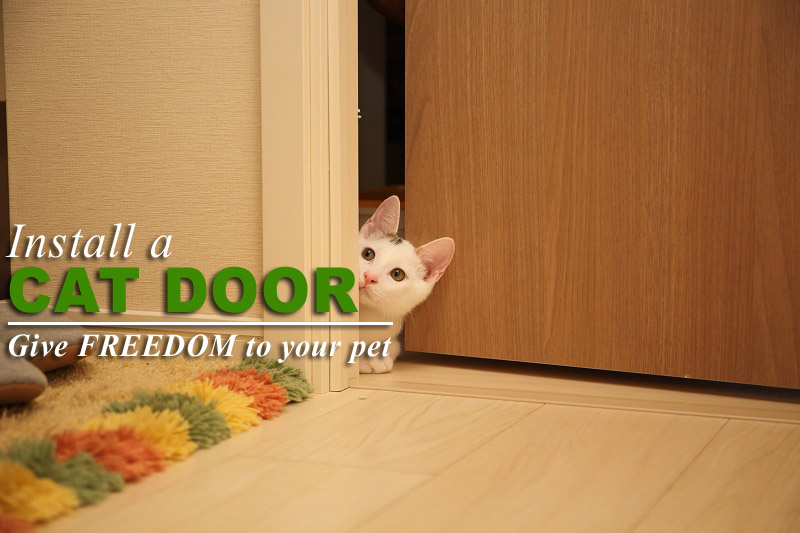
Does your cat like to wander the great outdoors right as you’re going to sleep or put on a movie? Well, a cat door might be the perfect solution to both of your problems!
With a cat door insert, your pet is free to wander even when you’re not around. But, choosing the right cat door comes down to more than just a star rating. Firstly, you need to figure out the type of cat door according to the size of your pet, and how to install it?
Quick Answer: You can install a cat door flap in 10 easy steps:
- Take Accurate Measurements of the Cat
- Mark the Correct Location on the door
- Apply the Template
- Drill a hole at each of the four corners
- Cut with a Jigsaw
- Dry-Fit the Frame
- Final Installation (Secure with Screws)
- Sealing & Insulation (Essential for USA Weather)
- Perform a Flap Test
- Train the Cat
However, before installing it, it is crucial to be aware of a few important points—otherwise, you could face issues such as improper fitting, heat loss, or security risks.
In this guide, you will find:
- How to choose the right cat door
- Popular products in the USA
- Installation costs
- Step-by-step instructions
- Expert tips
Essential Tools and Materials
Before you begin, have all the following items ready:
- Measuring tape
- Pencil / marker
- Drill machine
- Jigsaw (with a wood-cutting blade)
- Screwdriver
- Level (for ensuring straight alignment)
- Masking tape
- Safety glasses
- Silicone sealant (for weatherproofing)
Tip: You can find all these tools and supplies at Home Depot or Lowe’s.
Types of Cat Doors in the USA
1. Door-Mounted Cat Door
- Installed by cutting directly into a wooden or metal door
- A permanent solution
- The most affordable option
2. Sliding Glass Door Insert
- Installs without any cutting
- Best for renters
- Slightly more expensive
3. Wall-Mounted Cat Door
- Installed by creating a tunnel through the wall
- Offers superior insulation and durability
Installation Cost in USA (2026 Updated)
| Type | DIY Cost | Professional Cost |
| Door Mount Car Door | $20–$100 | $150–$300 |
| Sliding Cat Door Insert | $150–$500 | $200–$600 |
| Wall Mount Cat Door | $100–$300 | $300–$800 |
Pro tip: If you are installing for the first time, it is safer to hire a professional for $150–$250.
Step-by-Step Cat Flap Installation (Door Mount)
Step 1: Take Accurate Measurements of the Cat
Incorrect sizing is the most common mistake. Therefore, it is crucial to take accurate measurements of the cat.
✔ Measure the cat’s shoulder height (from the ground to the shoulder).
✔ Check the width (the widest part of the body).
Ideal Rule:
- Door opening = Cat’s height + 1–2 inches extra
- If it is too small → The cat will not use it.
Step 2: Mark the Correct Location
Choosing the right spot on the door is crucial.
✔ Mark 4–6 inches above the ground.
✔ Ensure center alignment.
✔ Check for wiring or metal reinforcement inside the door.
Tip: Apply masking tape before marking—this ensures a clean cut.
Step 3: Apply the Template (The Most Important Step)
Most products (such as PetSafe or Ideal Pet) come with a paper template.
✔ Tape the template to the door.
✔ Use a level to ensure it is not tilted.
✔ Trace the outline with a pencil.
Mistake to Avoid: Do not cut without using the template.
Step 4: Drill Holes (For Cutting)
✔ Drill a hole at each of the four corners.
✔ The hole should be large enough to allow the jigsaw blade to pass through.
Tip: Drill slowly to avoid damaging the door.
Step 5: Cut with a Jigsaw
This is the most critical step.
✔ Insert the jigsaw blade through the drilled hole.
✔ Cut slowly along the outline.
✔ Do not apply excessive force.
Safety: Wear safety glasses and keep your hands steady.
Pro Tips: Cheap doors cut quickly and solid wood doors take longer so cut the door carefully in the required dimension.
Step 6: Dry-Fit the Frame
After Cutting:
✔ Insert the cat door frame into the hole to check the fit.
✔ The fit should be tight and straight.
Tips:
- If it is too tight to fit the frame, perform some light sanding.
- If it is too loose, apply sealant after installation.
Step 7: Final Installation (Secure with Screws)
✔ Align both parts of the frame (inside + outside)
✔ Insert the screws and tighten them
Tips:
- Over tightening may cause the plastic to crack
- Tighten evenly
Step 8: Sealing & Insulation (Essential for USA Weather)
✔ Apply silicone sealant along the edges of the frame.
✔ To prevent cold air and water ingress.
Tip: Cold States (NY, Chicago):
- Add weather stripping.
- A double-flap door is recommended.
Step 9: Perform a Flap Test
✔ The flap should open and close smoothly.
✔ Check whether the magnet is functioning properly.
Step 10: Train the cat
- Use treats to invite cat to use the cat door.
- Initially, hold the flap open to demonstrate it.
Points to Consider Before Cat Door Flap Installation
1. Insulation
If you are in colder states (New York, Chicago):
- Opt for a double-flap door.
- Weather stripping is essential.
2. Security
- Smart or microchip-enabled doors offer greater security.
- Large openings can increase the risk of burglary.
3. Pet Size
- Measure your cat’s height and width.
- A small flap results in uncomfortable usage.
Expert Tips
- Choose energy-efficient doors (to save on heating/cooling costs)
- Aluminum frames are more durable
- Check HOA rules (some communities do not allow them)
- A locking mechanism is essential for sliding inserts
FAQs
Q1: Is it easy to install a cat door?
Answer: Yes, DIY installation is possible with basic tools—but for beginners, professional installation is recommended.
Q2: Does it cause energy loss?
Answer: Yes, but this is minimized by using insulated or double-flap models.
Q3: Can renters install a cat door?
Answer: A sliding glass insert is the best option—it causes no permanent damage.
Q4: Which is the safest cat door?
Answer: Microchip-enabled doors (such as SureFlap) are the most secure.
Conclusion
Installing a cat door is a practical upgrade for homes in the USA—but choosing the right product and installation method is essential.
- If you’re on a budget → Basic door flap
- If you prioritize convenience → Sliding insert
- If you need security → Smart microchip door